
Elihu Burritt: Linguist, Pacifist, Philanthropist
Born December 8, 1810, Elihu Burrit is considered one of New Britain’s most important and globally influential founding fathers. Known as the “Learned Blacksmith” and the “Apostle of Peace”, his work as a diplomat, philanthropist, orator, abolitionist, and author of 37 published works have cemented his place in New Britain history.
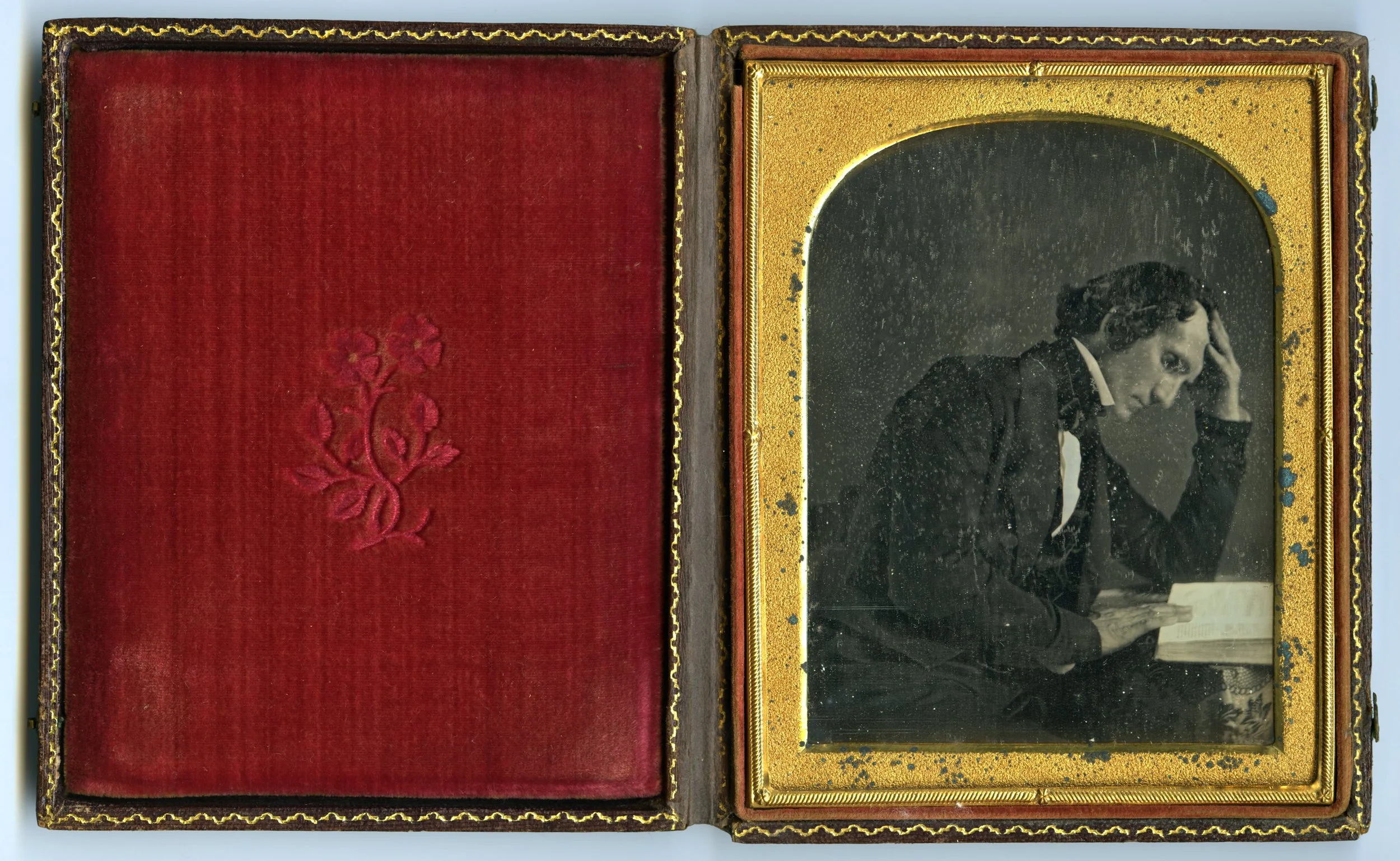
Elihu Burritt, seated portrait. C. 1840-1849. Daguerreotype. Catalog of the American Antiquarian Society, Worcester, MA.
As a young man, he apprenticed at sixteen and then worked as a blacksmith in New Britain, where he taught himself mathematics while working at the forge. In 1837 he went to Worcester, MA where he continued his smithing career and self-education, learning a great number of languages, including Latin, Greek, French, Spanish, Italian, German, Hebrew, and more. This earned him the title “Learned Blacksmith”, and he began to work as a translator. It was through this that he was introduced to Henry Wadsworth Longfellow and became a popular lecturer and writer, founding a local weekly newspaper called The Christian Citizen.
Soon enough, he turned his attention to the idea of world peace and an end to human suffering, or as he dubbed it, Universal Brotherhood. He briefly joined the pacifist group the American Peace Society, then in 1846 moved to Birmingham, England, where he founded his League of Universal Brotherhood. During his travels across Britain and Ireland, he discovered the plight of the Irish peasantry due to the potato famine and wrote A Journal of a Visit of Three Days to Skibbereen. This was instrumental in making the American public aware of the famine and its terrible consequences. Burritt was also responsible for communicating to the United States the ways in which they could assist the Irish people, as in this letter published in the Hartford Courant on February 27, 1842:
“Friends of Humanity! Hundreds of your fellow beings are dying, almost daily dying, of starvation in poor Ireland. Will you send them some bread from your plenteous boards? It has been stated that more have perished by famine in that afflicted land, than those who fell by the cholera in that dreadful year of death. A penny a day will save a human life. Will you let thousands die when they can be rescued so cheaply from the grave? The God and Father of our Lord Jesus Christ forbid! Farmers, Mechanics, Merchants, men of the United States, children, wives and mothers, will you let thousands of your kind be thrown uncoffined into the grave, when two cents worth of Indian meal a day will save human life?…The English government, as you see below, has promised to pay the freight of all contributions of food and clothing which may be forwarded from the United States. Will not the railroad companies in the United States, and steamboat companies, transport from the interior to the seaboard all such contributions free of charge? All these contributions may be consigned to the Society of Friends in England, who have made arrangements for extensive distribution to the starving, or to any other parties that may be preferred.”
Burritt also took up another cause– the abolition of slavery. “How pleasant it is to think– be it true or false– that cold, hard-soiled, pure-skyed New England is, indeed, a free land! That in her long struggle for freedom, she expunged from her soil every crimson spot, every lineament of human slavery, that inhuman institution! … there was not a foot of soil in New England– not a spot consecrated to learning, liberty, or religion– not a square inch on Bunker hill, or any other hill, nor cleft, or crag, or cavern in her mountain sides, nor nook in her dells, or lair in her forests, nor a hearth, nor a cabin door, which did not bear the bloody endorsement in favor of slavery,” he wrote in Sparks from the Anvil in 1847. Burritt advocated for compensated emancipation, a method of ending enslavement by which enslavers were to be given monetary or other forms of compensation in exchange for manumitting the enslaved person. This proposed method received some support, especially in Connecticut, but never came to fruition. Burritt travelled over 10,000 miles in his lifetime lecturing on and advocating for abolition.
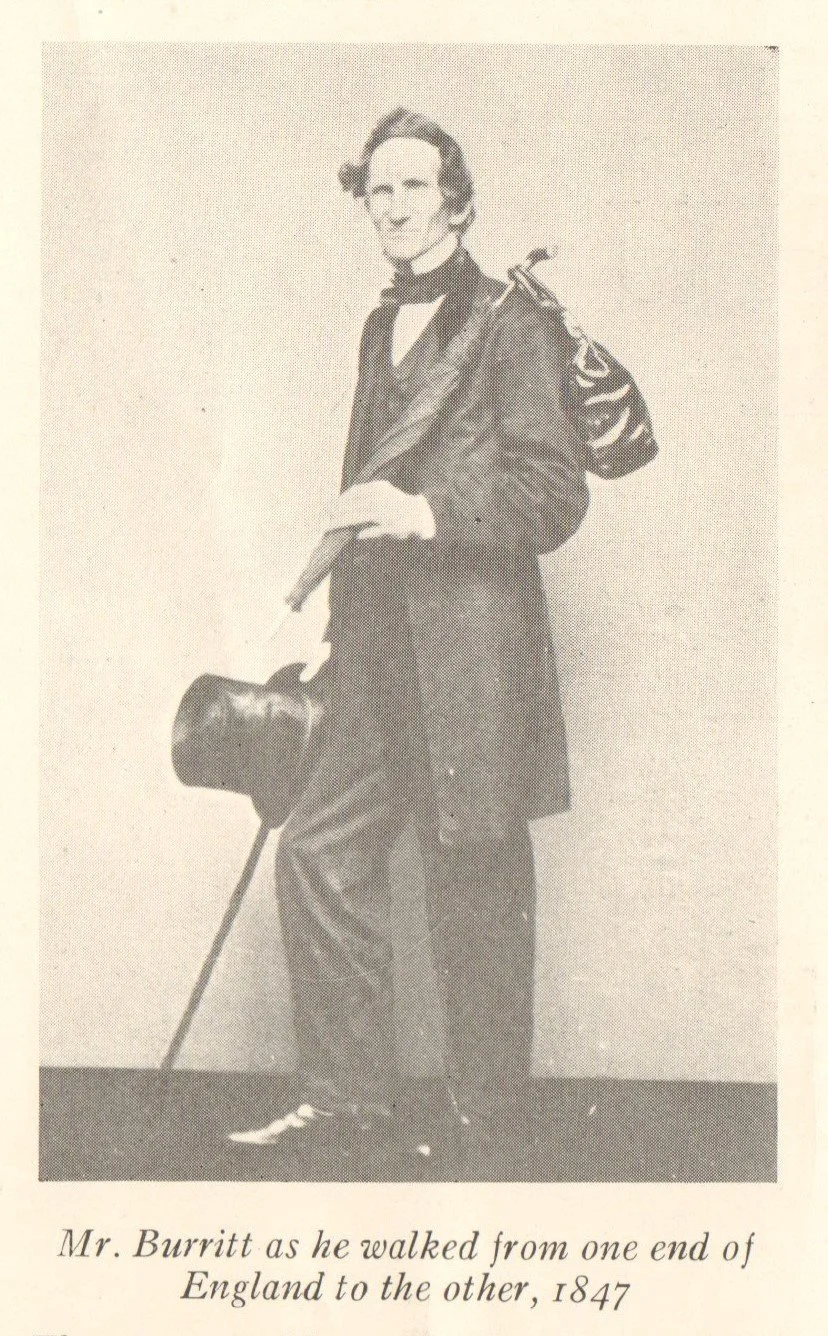
Mr. Burritt as he walked from one end of England to the other, 1847. New Britain Chamber of Commerce Magazine, April 1926. Collection of the New Britain Industrial Museum.
Burritt’s dedication to Universal Brotherhood and his work lecturing across both the United States and Britain, covering more than 10,000 miles, ultimately led to his appointment as United States Consul in Birmingham, England in 1864 by President Lincoln. His work also included advocacy for “ocean penny post” in Britain, a reduction in international mailing and shipping costs that he believed would encourage international correspondence, trade, and cooperation.
Burritt retired to his home in New Britain in 1870. He died in 1879 after a long illness and is buried in Fairview Cemetery. His legacy as an abolitionist, scholar, linguist, and philanthropist lives on in the city, particularly in the motto he coined: “Industria implet alveare et melle fruitur”, or “Industry fills the hive and enjoys the honey.” The Elihu Burritt Library at Central Connecticut State University bears his name and houses a special collection of his books, manuscripts, photographs, and letters.
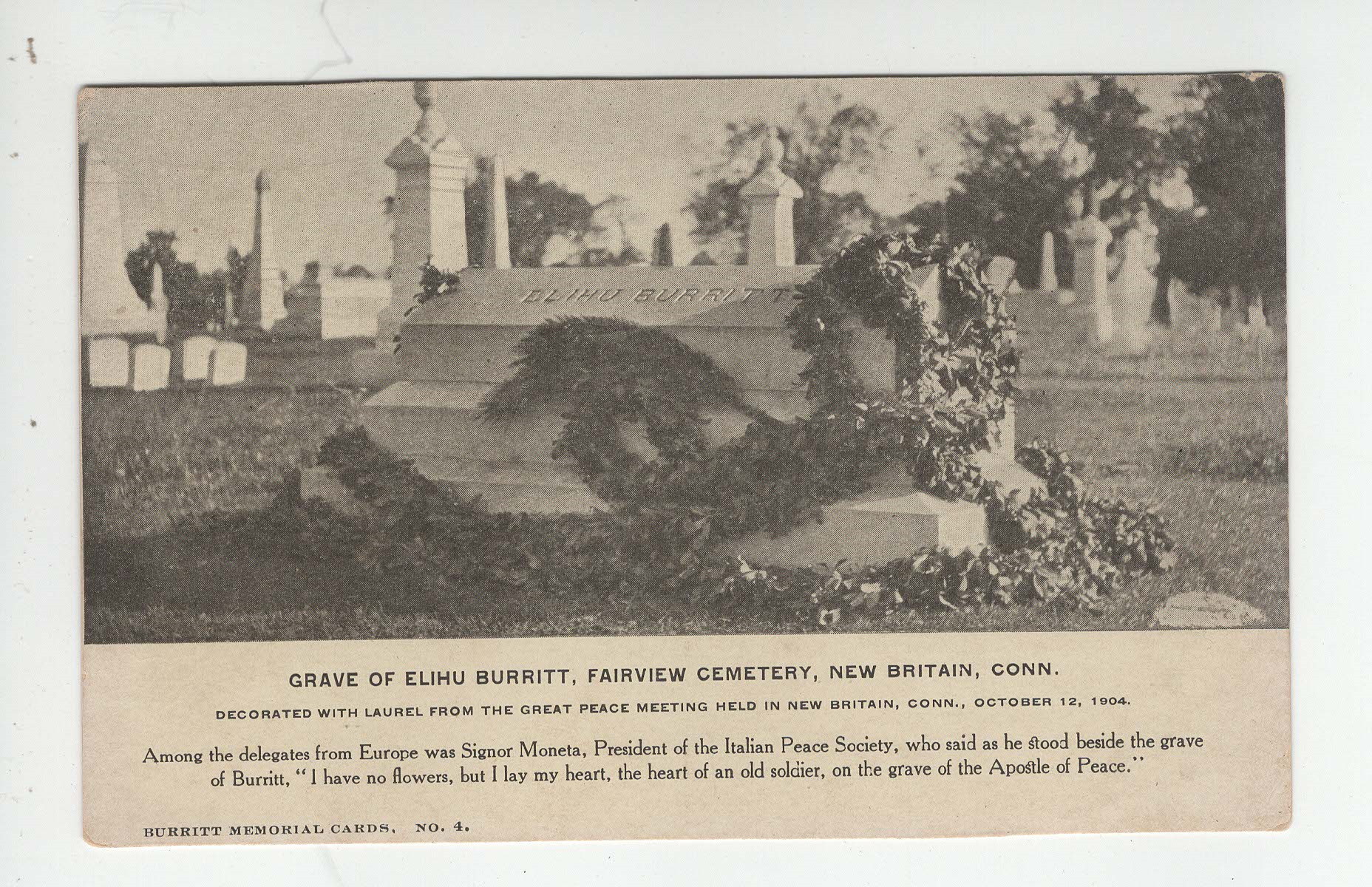
Grave of Elihu Burritt, 1904. Memorial card. Buckwell Postcard Collection, New Britain Industrial Museum.
To learn more about Elihu Burritt and his legacy, you can visit the resources below, and look forward to the re-opening of the New Britain Industrial Museum in its new home at 30 High Street, on a date to be announced.
Further Reading
Sparks From the Anvil by Elihu Burritt (1847)
Elihu Burritt Library - Central Connecticut State University
America and the Law of Nations 1776-1939 by Mark W. Janis (2010)
History West Midlands | Elihu Burritt - Birmingham and Black Country Lives
Death of Elihu Burritt, The Sterling Gazette, Sterling, Kansas, Thursday, 13 March 1879
Free Freight for Ireland: AN OLIVE LEAF FOR THE AMERICAN PEOPLE To the Right Hon. Lord JOHN RUSSELL, First Lord of the Treasury, Hartford Daily Courant, Hartford, Conn., 27 Feb 184